
kenoathtravels.com - lombok

To all those people who are interested in going to Lombok, do it.
We spent 5 days here and had a ball. It was our first trip to Lombok, and will not be our last.
Don't worry, Lombok is very safe, and the people seem much friendlier than in Bali.
In Bali you get hounded to buy something (watch, rings, etc) the same happens in Lombok (we stayed at Senggigi Beach), but when you show that you are not interested they get into a conversation with you and you finish up talking away with them.
They did have some problems in Lombok in 2000 but it was not as bad as the paranoid media made it out to be.
The trouble was very isolated and the locals and ex-pats we talked to said it was just a media beat-up and various misinformed embassies freaked out and discouraged people to visit Lombok.
There are no such problems here now.
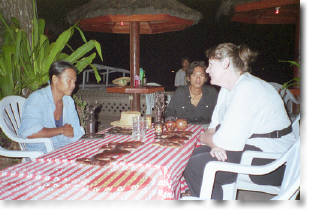
We stayed at a couple of hotels in Sengiggi Beach and they were excellent. There aren't too many tourists in Lombok at the moment (March/April 2001) so there are some great accommodation deals which makes the old budget stretch very far. And there are restaurants which have food that will make your mouth water!
From Bali to Lombok you can fly or take a ferry. The fast ferry from Benoa Harbour will cost you $US35 and take 2 and a half hours. But there is a slow ferry from Padangbai which takes 4 hours and cost 9500 rupiahs (about $A1.80). It was great fun with all the noises and smells of South East Asia, and a lot bloody cheaper!!
We have great contacts in Bali and Lombok now so if you're interested in places to stay in Bali or Lombok let us know, we can forward addresses, etc. And a little bloke called Eppoel who runs the internet cafe in Senggigi Beach hires cars, push bikes, motor bikes and runs tours at very reasonable prices.
So, go for it, you will be silly if you don't . . .
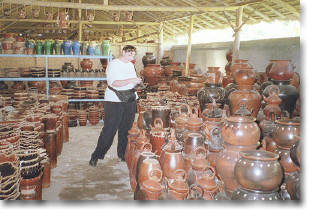
Lombok Pottery is well known around the world and while stretching the legs around that neck of the woods we had a squiz at one of their factories. The only problem when faced with such a selection is what to buy?
Ed had a problem deciding but came up with a gem called a Magic Jug. You pour water into a hole at the bottom and when you turn the jug upright the water stays in until poured . . . magic . . .
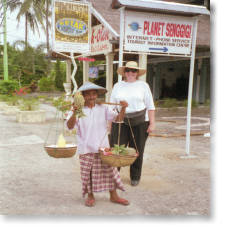
This little bloke hounded us all afternoon at Senggigi Beach until we finally gave in and purchased some fruit from him.
Well, you haven't tasted fruit until you get the genuine article from a little fruitseller in Lombok.
Unlike the tasteless fare that they jokingly call fruit here in Australia these mouth watering delights make the mouth dance with their favour and, well, just flavour!
And at a fraction of the cost back home there is no excuse for contracting scurvy with this bloke around.
Wooden articles are a great hit with tourists in Lombok, and there are about a million different types of carvings for you to ponder over.
Here in this picture we are witness to a steel willed transaction about to take place as our unsuspecting tourist is about to be put under pressure by our wandering seller of prized ornate Gekos (even if one was a dud).
Kerry Packer would be way out of his league here.
While heading up to the North of Lombok we came across an extremely busy morning market.
Here you can buy anything your heart desires and even things that you have never seen before!
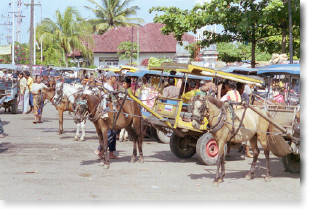
And the local punters arrive in cars, motorbikes, bemos and even these little horse drawn cart thingies.
In fact this is a picture of the taxi rank out front of the markets.
A BIT MORE INFORMATION ON LOMBOK AND SURROUNDING ISLANDS.
ALL THERE . . . READY FOR YOU TO EXPLORE . . .
As a tourist destination, Lombok is different from Bali, and is unique in itself. In Lombok one can find aspects of Balinese life but not vice-versa in the case of Bali. In the western part of Lombok, Hinduism and Islam co-exist, and there is a strong influence from Shiwa Buddhism. This influence originated from Java which subjugated Lombok before the arrival of Islam.
In the 17th century, the king of Karangasem on Bail island subjugated Lombok, weaving the histories of both islands. Lombok prospered under the new ruler and became a centre of Hindu-Balinese influence.
Today, though the Balinese are a minority group, they still have considerable influence on the western part of Lombok. Vestiges of the Karangasem influence can be seen in the city of Cakranegara. A famous landmark, for instance, is the Pura Mew Temple, built in 1720 by Anak Agung Karang which is dedicated to the Hindu trinity of Brahma, Wisnu and Shiwa. Also of Balinese origin is the famous Taman Narmada built in 1727 by Anak Agung Gde Ngurah Karangasem, which is both a recreational park and a place to worship Shiwa.
But despite this Hindu influence, Lombok is essentially a hioslern island. Islam came first from Java, and then from Sulawesi, whose sea-faring Bugis set up the Eastern Kingdom of Selaparang in the 17th century. So the religious mix is remarkably complex.
Most of the Sasak people of Lombok follow a brand of Islamic orthodoxy professed by traditional teachers, which is known as "Tuan Guru". Others follow the syncretist tradition of "Wetu Telu". Instead of praying five times a day as Moslems usually do, they pray only three times a day, and have a cosmology influenced by Hinduism. There is even a temple in Lingsar where people from Hindu and Islamic traditions meet for common prayer.
Besides the Balinese and Sasak, there are also Bugis in Lombok Islands.
The region of the Lesser Sunda islands, of which Lombok is but a part, covers an area as wide as Java. lt has a great variety of ethnic groups, with an increased Melanesian influence the further one goes east. There are at least 33 main languages. Some islands are highly Islamic (like Lombok and Sumbawa).
The area is no less varied geographically. The Nusa Tenggara islands are the most varied in Indonesia: their landscape ranges from Lombok's volcanoes to Sumba's and Flores' dry savannahs. There are also colorful atolls in many parts of this region.
Lombok is where the transition towards Eastern Indonesia begins, both naturally and culturally. The northern part of Lombok is mountainous and verdant with tall trees and shrubs covering the land. One finds none of the large Asian mammals. The western part of the island is the greenest and most humid. As one moves east, the dry season becomes more pronounced, and in many areas corn and sago, instead of rice, are the staple foods
Lombok's principal mountain is the 3726-meter high Mt. Rinjani, third-highest in Indonesia. Still active, it last erupted in 1901. Mountains play an important role in Sasak tradition. Both the Sasak and Balinese people have a yearly pilgrimage to Rinjani's summit, which several sulfuric lakes with curative virtues. Mount Rinjani also offers trekking through the rain forests.
Mataram, the capital of West Musa Tenggara, together with Ampenan, the port, and Cakranegara, the old Balinese capital, make up the largest urban area in the Nearby Sweta has the largest traditional marKet, including birds. Very different from the atmosphere of urban Lombok is a traditional village such as Sukarare, famous for its weaving, and Penunjak, famous for its pottery.
Lombok has a large array of beautiful beaches. Kute Beach (also known as Putri Nyale Beach), is on the south coast of Central Lombok. The answer to Bali's Kuta, albeit much less developed, Kute is one of the most scenic and unspoiled beaches on the island. From Kute to Tanjung Aon, five kilometers away, there is an unbroken stretch of sand. The sea is safe for bathing and swimming.
Further to the west are several surfing and windsurfing beaches. Each year, on the 19th day of the tenth month of the Sasak lunar calendar, when the Nyale fish come to sea surface, Kute beach hosts the famous Nyale festival.
But Lombok's chief resort is Singgigi beach, offering a range of accommodation, with the best hotels on the island situated here. A recommended choice is Puri Saron. Corals can be seen in abundance just off-shore.
Gili in the Sasak language means island. The three Gili Islands, Gili Air, Gili Trawangan, and Gili Meno are idyllic islets just off the northern coast. A favorite with backpackers, the islands abound with coral gardens. Gili Air, the nearest island, can be reached in 10 to 15 minutes by boat from the mainland.
One of the best ways to enjoy the splendor and beauty of the Gilil islands is to go on a cruise on the 5-star luxury catamaran, The Bounty Cruises. equipped with international standard safety equipment computerized stabilizer, it makes the sea journey Benoa harbor in Ball to Gill Meno in just two-and-a-halff hours. During the journey, guests can enjoy deck and in-house videos or simply sun-bathe.
At the island, The Bounty Cruises will moor alongside a pontoon, allowing opportunities for snorkeling or scuba diving. The blue tinted staghorn corals are one of the attractions here.
On Lombok, nature enters a new geographical zone, the intermediate zone between Asia and Australia. The staple foods are sago, corn, or cassava. Paddy is scarce as cattle rearing replaces agriculture as the main activity of the local people. The other important economic activity is the making of pottery, which is gaining worldwide fame. Pottery is produced mainly in the villages of Banyumulek, Masbagik Timur and Penuiak. Here, women have been involved in this craft since the decline of the Hindu Kingdom of Majapahit in the early 16th century. Technically, there are few differences in the processes used in the three villages except that the designs of the pots are different.
Slnce 1988, the Lombok Crafts Project, Jointly run by the Governments of the Republic of Indonesia and of New Zealand, has been providing technical and marketing assistance to these women potters. It has assisted them to process their clays in ways which produce a stronger product.
The earthenware clay used is greyish brown in its natural state but becomes a beautiful rich red brown when fired. Finished pots are coated with a slip made from the same clay, sieved to produce a fine surface which is later burnished with stone. The clay used to produce Sasak pottery has been approved for food safety by the New Zealand Department of Scientific and Industrial Research. Such pottery items, ranging from food storage containers to cooking utensils and water jars, are available from Lombok Pottery Centre in Cakranegara. Totally hand-crafted, Sasak pottery is intrinsically fragile but if handled with care will last many years.
The island of Sumba is renowned for its intricate ikat handweavings, onto which people symbolically record moments in their lives, and the history of their communities. Corn and sweet potatos are the staple food in Sumba..
Some Sumbanese still follow the indigenous Harapu religion, and there are many remnants of this ancient tradition in the hinterland plateau. Rende and Malolo, in East Sumba's hinterland, have traditional communities with Sumbanese palaces and the original Marapu tombs.
Sumba's beaches are unspoiled, being particularly beautiful around Waikabubak, West Sumba. Many remarkable birds and butterflies are endemic to Sumba, and are therefore seriously threatened. A small national park near Waingapu is a good place for watching butterflies and birds.
Another island in the Musa Tenggara chain is Sumbawa, whose 2200m Mount Tambora, erupted in the 18th century, killing most of the local population (about 30,000 people). The biggest town is Sumbawa Besar. The island is predominantly Moslem, with some Christian communities. The palace belonging to the ancient Bugis Sultan of Sumbawa, Dalam Luka, can be visited, as can Bima and Sape, two other interesting places.
Flores means "flower" in Portuguese, and the island which takes this name is one of the main islands in East Nusa Tenggara. It was a Portuguese colony for a long time before the Dutch took over. Many of the local people are of Portuguese descent and still retain Portuguese names. Catholicism is the main feature in the many villages of Flores and of some of the small islands nearby. Every year the Paso Easter procession is held in Larantuka, the town-house of the Black Madonna of Flores. This westernized island has many untouched beaches and pristine underwater coral gardens. There are shark hunter villages in Lamalera and the small island of Lembata.
The mainland is famous for its tricolor caldera's lake on Mt. Kelimutu, whose combination of colours change according to the volcanic activity. The women made ikat weavings from Flores are well known amongst collectors. It has many style as there are dialects: about 15 altogether.
Between Sumbawa and Flores is Komodo island, a Jurassic Park of an island, home to the giant four metre long Komodo dragon lizard, which can weigh up to 150 kilograms. June and September are the best months to observe this endangered prehistoric monster up close. When watching this living dinosaur, visitors offer goats as bait to make the monsters demonstrate their "beastliness". But be careful! There are stories of European tourists whose cameras were the only things which returned home. Unusually, the sand on this island's beaches has a pink hue.
On each island of Nusa Tenggara, the traditional houses are particularly beautiful and the traditional markets unique. Apart from the larger islands of Nusa Tenggara, there are many smaller islands ready to uncover their beauty and richness. They represent future challenges for the indonesian tourism industry.